Can India become a global hub for high-voltage equipment manufacturing
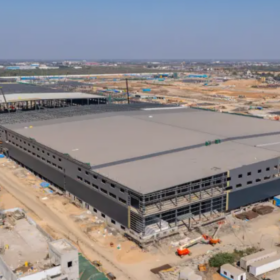
For years, India has depended on imports of transformer bushings particularly at higher voltage levels. For India to become a global manufacturing hub, the gaps in product design, manufacturing technology must be addressed with a sense of urgency.
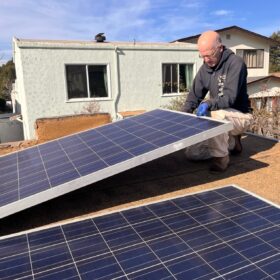
DIY plug-in solar shows $0.65/W potential in US market
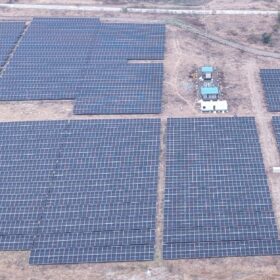
Achieving a system cost of $0.65/W through the secondary market and do-it-yourself assembly demonstrates a viable pathway for US plug-in solar to provide immediate utility bill relief to renters and apartment dwellers.
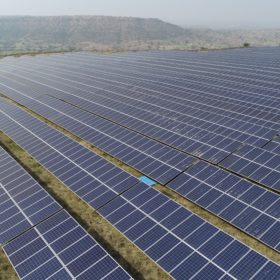
Reforming Captive Power in India: Key Changes under the Electricity (Amendment) Rules, 2026
While the Amendment retains core eligibility thresholds for qualifying as a captive generating plant under Rule 3, it provides clarity on several existing interpretational ambiguities to align it with judicial precedents and contemporary corporate structures.

India’s pipeline push: Building the backbone of energy security
In addition to traditional oil and gas transportation, pipeline technology is evolving to support the future energy mix. As India moves toward greater adoption of cleaner fuels, including natural gas and low-carbon energy systems, pipelines capable of handling new energy vectors will become increasingly important. This shift is encouraging the adoption of specialised pipe solutions designed for higher efficiency, safety, and long-term operational resilience.

Solar generation performance with regional weather conditions deviating from long-term averages
Global solar PV continues its rapid growth, reaching around 650 GW in 2025, with record solar irradiation extremes across regions such as East Asia, India, and Latin America. With current production capacity and emerging technologies like perovskite-silicon tandem modules, PV is poised to surpass all other electricity generation technologies combined by the end of the decade.

Tongwei moves into hybrid heterojunction back contact solar cell technology
Tongwei is partnering with GS-Solar and Golden Solar to develop a large-scale manufacturing facility for hybrid heterojunction back-contact (HBC) solar cells that combine heterojunction passivation, tunneling oxide and polysilicon structures used in TOPCon designs, and the grid-free front-side architecture typical of back-contact technologies.

US ITC opens Section 337 probe into global TOPCon supply chain
The US International Trade Commission (ITC) has opened a Section 337 investigation into tunnel oxide passivated contact (TOPCon) solar cells, modules, panels, and related products following a complaint by First Solar, naming 47 entities across 11 countries as respondents.
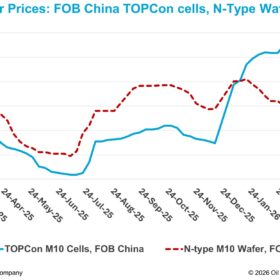
China solar cell prices fall for third consecutive week as upstream costs ease
In a new weekly update for pv magazine, OPIS, a Dow Jones company, provides a quick look at the main price trends in the global PV industry.

How to build trust in peer-to-peer electricity trading with blockchain in solar energy space
Trust, more than technology or economics, is the real bottleneck in scaling peer-to-peer (P2P) electricity trading. And increasingly, blockchain is being positioned not as a buzzword, but as a structural solution to this problem.
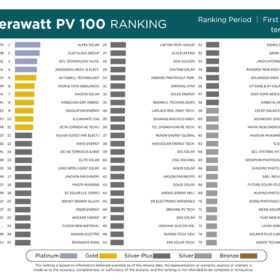
Who are the Top 100 PV manufacturers today?
The Terawatt PV 100 ranks the top 100 solar manufacturing companies using a new methodology based on production scale, financial strength, and corporate transparency, with Tongwei leading the Q1 2026 list and most top firms headquartered in China. The analysis highlights increasing global supply-chain scrutiny driven by tariffs and ESG mandates, while also showing rising influence from Indian companies and strong positions for key materials and equipment suppliers.