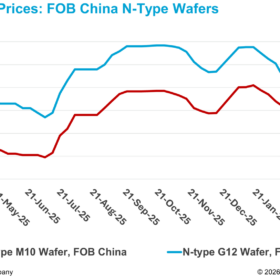
China wafer declines narrow as demand-side regulation lifts market sentiment
In a new weekly update for pv magazine, OPIS, a Dow Jones company, provides a quick look at the main price trends in the global PV industry.
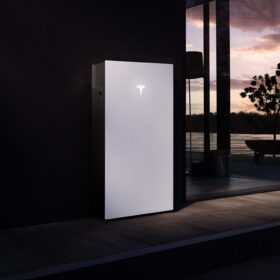
Tesla launches three-phase Powerwall 3P
The system integrates a battery, hybrid inverter, and home energy management system into a single device. It supports the integration of additional appliances, including heat pumps via SG-Ready interfaces. A connection to Tesla’s proprietary wallbox is also planned.
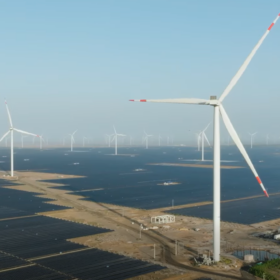
Adani Green’s operational RE capacity grows 35% YoY to 19.3 GW
The company reported revenue from power supply of INR 11,602 crore in FY 2026, marking a 22% year-on-year increase. EBITDA from power supply rose 23% YoY to INR 10,865 crore—almost twice the annual EBITDA for FY23.

Doing more with less: The new imperative for clean energy
The clean energy transition carries a real risk of replicating the extractive habits of the fossil fuel era, just with different inputs. Land grabs for solar. Rare earth mining for batteries. Water consumption for green hydrogen. None of these are arguments against the transition. They are arguments for doing it intelligently. Floating solar is one example of that intelligence made practical.
India’s EV and battery manufacturing future depends on states playing to their strengths: IISD
State that aligns policies—and target specific segments of the EV and battery value chain—based on their comparative advantage, can better attract investments, deepen local value addition and create integrated manufacturing ecosystems.
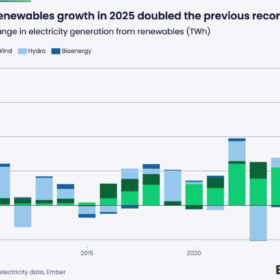
Record solar, wind surge drives 3.3% drop in India’s fossil generation in 2025
India’s renewable power generation from solar, wind, hydro and bioenergy rose by a record 98 TWh (+24%) in 2025, driven by strong growth in solar and wind, according to a report by Ember. The increase was twice the nation’s electricity demand growth of 49 TWh, which was abnormally low owing to milder temperatures and slower industrial activity. As a result, India’s fossil power generation fell by 3.3%.
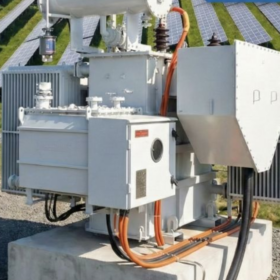
Saatvik Green Energy acquires 80% stake in Melcon Transformers
Indian solar manufacturer Saatvik Green Energy has acquired an 80% equity stake in Melcon Transformers and Electricals, a Jaipur-based transformer manufacturer. The acquisition gives Saatvik a manufacturing footprint in power transmission equipment, a segment linked to India’s renewable energy expansion.
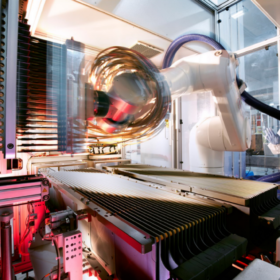
Trina Solar, JA Solar, JinkoSolar launch China’s first PV patent pool for TOPCon technologies
China’s solar industry has launched its first TOPCon-focused patent pool, led by Trina Solar, JA Solar, and JinkoSolar, to streamline licensing, reduce disputes, and strengthen IP coordination at home and abroad.

Why semiconductors in the solar sector require mainstream attention
As the energy-generating capacity scales up, it becomes critical to integrate intelligent embedded control and connectivity solutions. With a concerted effort to utilize the advances in power electronics and connectivity solutions, it is possible to achieve self-reliant, environmentally friendly, and efficient energy systems that can power a nation.

Sterling and Wilson Renewable Energy Ltd reports INR 7,548 crore revenue in FY2026
Sterling and Wilson Renewable Energy Ltd (SWREL) has reported consolidated revenue from operations of INR 7,548 crore for FY2026, its highest since listing.